What Every Woodworker Should Know About Teak Before Starting a Project
Teak woodworking is one of the most rewarding — and demanding — skills in all of furniture craft. Teak (Tectona grandis) is native to the rainforests of Burma, India, Laos, and Thailand, and is now grown in roughly 40 tropical countries. Its legendary durability, natural oils, and stunning golden-brown color make it the gold standard for outdoor furniture. But those same properties make it genuinely tricky to work with.
Here is a quick overview of the essentials:
| Topic | Key Fact |
|---|---|
| Hardness | 1,000–1,070 lbf Janka — about 16–22% softer than red oak |
| Tool wear | Silica content (1–3%) dulls blades up to 3x faster than oak |
| Gluing | Natural oils require acetone prep before any adhesive |
| Finishing | Standard polyurethane fails — use penetrating oils or marine finishes |
| Stability | 33% more dimensionally stable than red oak — ideal outdoors |
| Moisture content | Kiln-dry to 8–12% before building to prevent warping |
| Best joinery | Mortise and tenon with wooden dowels for outdoor applications |
Teak is not a wood you can approach like pine or even oak. Its natural silica acts like microscopic sandpaper on your tools. Its oils resist glue and many finishes. And its grain can be unpredictable. Understanding why it behaves the way it does is the key to working with it successfully.
I am Elle, and I have been helping homeowners select and care for the finest outdoor teak woodworking projects since founding Goldenteak in 1996 — giving me nearly three decades of hands-on insight into what makes this wood perform beautifully for generations outdoors. Read on for everything you need to know before your first cut.
Quick look at teak woodworking:
Mastering the Unique Challenges of Teak Woodworking
To truly appreciate teak, we have to look past its beautiful honey-gold surface and dive into its unique cellular makeup. Many woodworkers are surprised to learn that teak is actually softer and lighter than Northern red oak. Teak has a Janka hardness rating of 1,000 to 1,070 lbf (making it 16% to 22% softer than red oak, which sits at 1,290 lbf). It weighs approximately 3.33 lbs per board foot, which is about 6.98% lighter than red oak, and has a specific gravity of 0.59.
Yet, despite being softer on paper, teak behaves like a tank in the workshop. Why? The secret lies in its natural chemistry. As teak trees grow, they absorb minerals from the soil, embedding microscopic particles of silica (essentially sand) directly into the wood grain. This is paired with an incredibly high concentration of natural oils and resins, specifically a compound called tectoquinone.
These Teak Wood Characteristics act as a built-in defense mechanism. The hydrophobic oils give teak an incredibly low water absorption rate of just 0.5% (compared to a whopping 15% for pine), making it virtually immune to rot, decay, and insect attacks. Furthermore, these Teak Properties provide unmatched dimensional stability. Teak’s radial movement coefficient is 0.0022 and its tangential movement is 0.0041, meaning it moves 33% less than red oak under seasonal humidity changes. It is the ultimate material for high-exposure outdoor settings, but managing these characteristics in the shop requires a specialized approach.
The Role of Silica and Oil in Teak Woodworking
If you try to machine teak with standard high-speed steel (HSS) blades, you will quickly hear your tools “screaming.” The 1% to 3% silica content in teak acts as a highly abrasive grit. In fact, cutting teak will dull standard steel tool edges up to three times faster than working with oak.
Furthermore, the dense, sticky natural oils can quickly heat up under the friction of a spinning blade, gumming up your cutters and causing the wood to burn. This means tool maintenance is a constant companion in teak woodworking.
When sourcing your timber, understanding the different Teak Grades is critical. Grade A teak is harvested exclusively from the mature heartwood of the tree, where the concentration of protective oils and silica is at its absolute peak. While Grade A offers the legendary 50+ year outdoor lifespan we expect, it also demands the most respect in the workshop. Grade B and Grade C teak contain more sapwood, which is softer, less oily, and far easier to cut, but lacks the weather resistance needed for durable outdoor use.
Old-Growth vs. Plantation-Grown Teak
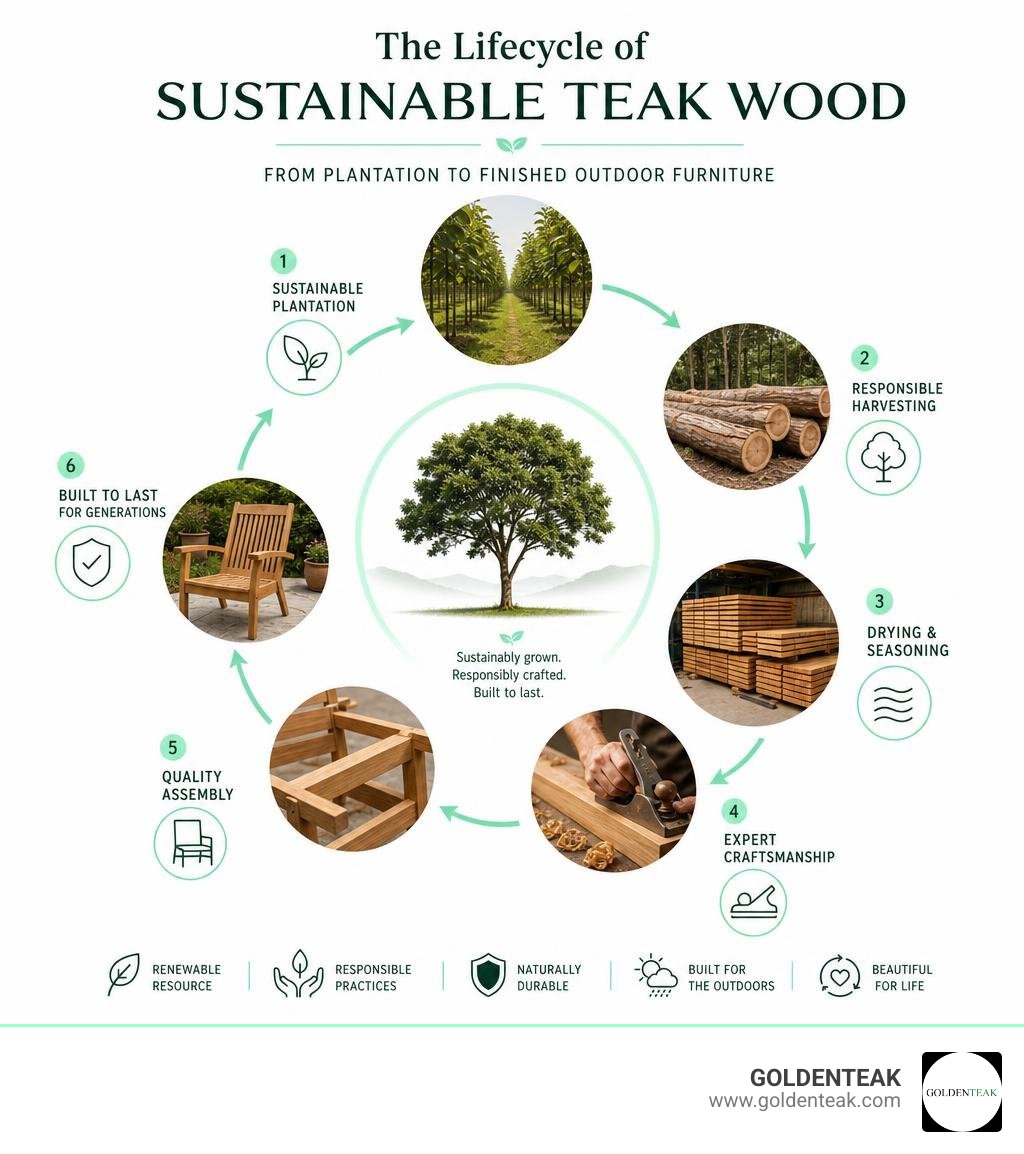
Historically, the world’s finest teak was harvested from old-growth forests in Southeast Asia. These slow-growing giants, often taking up to 300 years to mature, produced incredibly tight, straight grain. However, natural teak forests are highly endangered, with global supplies declining at an annual rate of 1.3%.
Today, responsible woodworkers and manufacturers rely on plantation-grown teak. Thanks to strict environmental regulations, particularly in Indonesia, planted teak forests have become a highly successful model for Sustainability.
When we look at Understanding Teak Wood Origins Quality, we find that mature plantation-grown Grade A teak (harvested at 45 to 50 years) matches the durability and strength of old-growth timber. Younger plantation crops harvested after only 10 to 20 years, however, produce lower-grade timber with wider grain and higher sapwood content. For high-end outdoor furniture, sticking to mature, sustainably sourced Grade A plantation teak ensures your hard work will survive the elements.
Machining, Tool Selection, and Moisture Management
Before you feed a single board of teak into your jointer or planer, you must adjust your typical machining strategy. Because of the abrasive silica, standard steel knives will lose their sharp edge after just a few passes. This leads to tear-out, burning, and unnecessary strain on your shop machinery.

Always use high-quality carbide-tipped blades and router bits when machining teak. Carbide is much harder than high-speed steel and can withstand the abrasive silica far longer. Keep your feed rates slow and steady; rushing the wood through a cut increases friction, which coaxes the natural oils to the surface, gumming up your blades and burning the grain.
Additionally, clean your blades frequently using a citrus-based cleaner or a pitch remover to keep them performing at their best.
Proper moisture management is also a critical step. Teak must be properly dried before you begin cutting joinery. Through Teak Kiln Drying, the wood’s moisture content is carefully brought down to an ideal 8% to 12% range. This relieves internal drying stresses and ensures the wood remains perfectly stable once assembled.
Blade Selection, Sharpening, and Safety Precautions
When planning your cuts, swap out your general-purpose saw blades for dedicated carbide-tipped blades with a lower tooth count to help clear the sticky, oily waste. If you are using hand tools, expect to spend plenty of time at your sharpening stones. Many woodworkers use a micro-bevel or a slightly higher bevel angle (around 30 to 35 degrees) on chisels and plane irons to give the cutting edge more support against the abrasive silica.
Safety is paramount when machining teak. Because of the high silica content, teak sawdust is highly abrasive and acts as a known sensitizer. Inhaling this fine dust can cause severe respiratory irritation, coughing, and over time, allergic reactions.
Always run an active dust collection system and wear a well-fitted N95 respirator. Never use compressed air to blow teak dust around your shop; instead, use a vacuum with a HEPA filter and wipe down your work surfaces with a damp cloth.
Additionally, wear gloves when handling raw teak. The wood’s natural oils can easily contaminate minor cuts, which woodworkers have noted can significantly delay the healing process and cause localized skin irritation.
Managing Moisture Content and Preventing Tear-Out
Because teak is so dimensionally stable, monitoring its moisture content is relatively straightforward, but still essential. Use a high-quality pinless moisture meter calibrated specifically for teak’s density. This helps you verify that your lumber has fully acclimated to your shop’s equilibrium moisture content (EMC) before you begin cutting tight joints.
To prevent tear-out on crosscuts and highly figured boards, use zero-clearance inserts on your table saw and apply painter’s tape along your cut lines. If you notice minor hairline cracks or checking on the ends of your boards during acclimation, don’t panic. This is a natural reaction known as a Teak Check, which typically occurs as the wood adjusts to changes in humidity. These small checks rarely affect the structural integrity of the wood and can easily be sanded out or sealed.
Joining, Gluing, and Finishing Outdoor Teak Projects
Putting teak together and making it stay together is perhaps the ultimate test of a woodworker’s patience. The very oils that make teak waterproof also try their best to repel adhesives and finishes. If you apply standard wood glue directly to raw teak, the bond will almost certainly fail within a few months as the migrating oils push the glue away from the wood fibers.
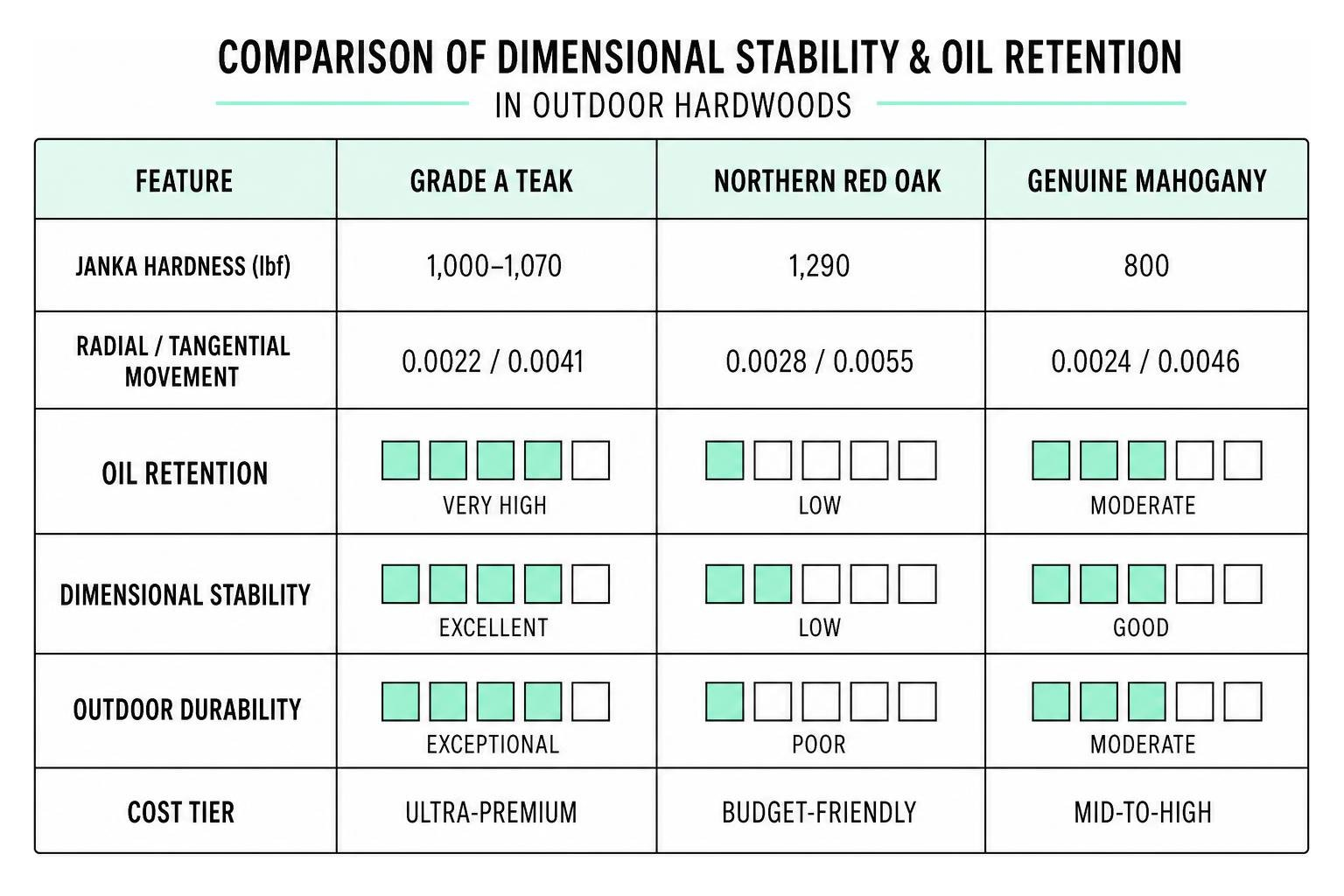
| Wood Species | Janka Hardness (lbf) | Radial/Tangential Movement | Outdoor Durability | Cost Tier |
|---|---|---|---|---|
| Grade A Teak | 1,000–1,070 | 0.0022 / 0.0041 | Exceptional (50+ years, rot/insect proof) | Ultra-Premium |
| Northern Red Oak | 1,290 | 0.0028 / 0.0055 | Poor (prone to rot and water damage) | Budget-Friendly |
| Genuine Mahogany | 800 | 0.0024 / 0.0046 | Moderate (requires constant sealing) | Mid-to-High |
Traditional Mortise and Tenon Joinery in Teak Woodworking
When we build outdoor furniture, we avoid relying solely on metal fasteners or screws. Over time, as the wood experiences minor seasonal expansion and contraction, metal hardware can work itself loose, creating small gaps where water can collect and rot the surrounding wood. Instead, we rely on traditional mortise and tenon joinery.
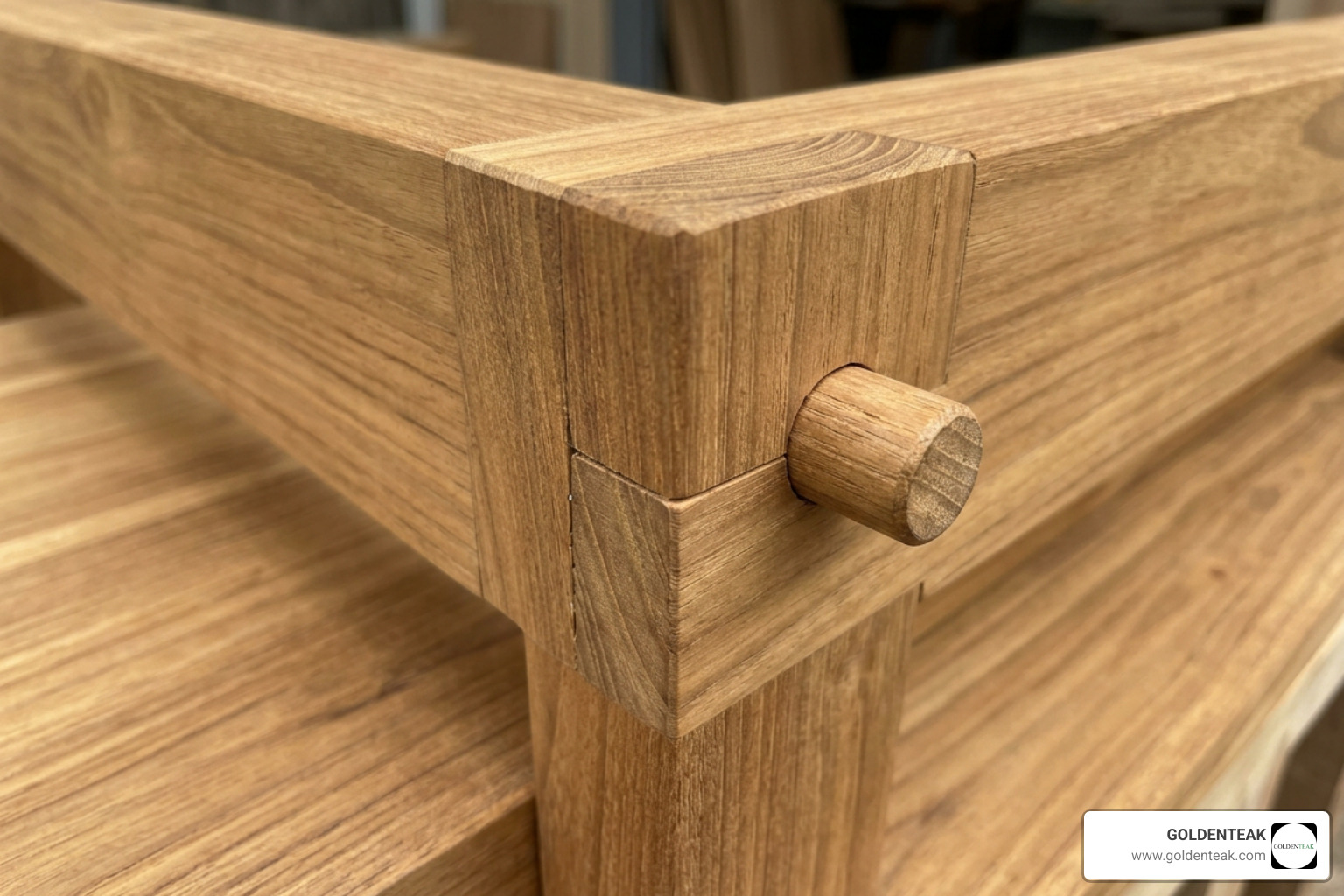
A precision-cut mortise and tenon joint provides incredible mechanical strength. By locking the joint together with a matching wooden dowel (or peg), you create a connection that allows the wood to expand and contract naturally without losing its structural integrity.
This is why we insist on using machine-cut mortise and tenon joints in all of our Grade A Teak outdoor furniture. It ensures the frames of our dining tables, benches, and deep seating sofas remain rock-solid for decades.
Surface Preparation, Adhesives, and Finishing Schedules
To get a glue joint that actually lasts on teak, you must perform a thorough solvent wipe. Immediately before applying your adhesive, scrub the joint surfaces with a clean rag soaked in 100% pure acetone. This temporarily strips the natural oils from the surface of the wood, opening up the pores.
You must apply your glue as soon as the acetone evaporates (within a few minutes) before the oils have a chance to migrate back to the surface.
For adhesive selection, standard water-based PVA glues should generally be avoided for critical outdoor joints. Instead, use a high-quality waterproof polyurethane adhesive like Titebond III, or a two-part marine-grade epoxy like West System epoxy. Epoxy is particularly effective because it fills minor gaps and creates an incredibly strong, waterproof chemical bond with the wood fibers.
When it comes to finishing, you have two main options:
- The Natural Route: You can choose to apply absolutely no finish at all. High-quality outdoor teak will naturally weather over the course of a few months into a beautiful, silvery-gray patina. This does not harm the wood’s durability in any way. If you ever want to restore the original golden-brown color, simply give the wood a light pressure wash and apply a “wood brightener” (oxalic acid), followed by a light sanding with 150-grit sandpaper.
- The Sealed Route: If you prefer to maintain that warm, honey-gold tone, avoid standard clear polyurethanes, which will quickly crack and peel under UV exposure. Instead, use specialized Teak Care Products. We highly recommend a breathable, water-based sealer like the Golden Care Water Based Teak Protector, which protects the wood from UV rays and lasts up to four times longer than traditional teak oils without attracting dirt or mildew.
Frequently Asked Questions about Teak Woodworking
Why does teak wood dull woodworking tools so quickly?
Teak trees naturally absorb silica (microscopic sand-like particles) from the soil as they grow. These tiny mineral deposits are distributed throughout the wood grain, acting like 80-grit sandpaper against the sharp cutting edges of steel jointer knives, planer blades, and chisels, causing them to dull up to three times faster than normal.
What is the best glue to use for outdoor teak joints?
For maximum durability outdoors, a marine-grade two-part epoxy (like West System) or a high-quality waterproof PVA glue (like Titebond III) is best. However, the most important step is the prep: you must wipe the joint surfaces with acetone immediately before gluing to strip away the natural surface oils, allowing the adhesive to penetrate the wood pores.
How do you prevent teak wood from cracking or checking outdoors?
The best prevention is starting with properly kiln-dried Grade A heartwood. Minor surface checking, or a Teak Check, is a normal part of the wood’s acclimation process during its first few months outdoors. These small checks do not threaten the structural integrity of the furniture and will naturally close up as the humidity changes.
Conclusion
Mastering the basics of teak woodworking requires patience, the right tools, and a deep respect for the wood’s unique physical properties. While its silica and natural oils present genuine challenges in the workshop, the reward is a piece of furniture that can withstand the harshest outdoor climates for generations.
At Goldenteak, we have dedicated ourselves to crafting the finest outdoor furniture using these exact time-tested techniques. From our Massachusetts showroom and warehouse, we import and distribute premium, sustainably sourced Grade A teak furniture. Whether you are looking for luxurious deep seating sofas, classic benches, or complete dining sets, our rigorous construction standards ensure every piece is built to last a lifetime.
If you are ready to bring the unmatched beauty and durability of premium teak to your home, explore our complete collection of Teak Patio Furniture today, or reach out to our team for expert advice on choosing the perfect pieces for your outdoor space.